

SEND Support and Graduated Approach
SEND Support and Graduated Approach
SEND Support
SEND Support is the category of support for:
- children and young people (CYP),
- with special educational needs and/or disabilities (SEND),
- who do not have an Education, Health and Care Plan (EHCP).
SEND Support refers to the additional provision, adaptations and support offered within educational settings. This is done in accordance with the SEND Code of Practice (2015) and is based on a graduated approach. It emphasises early identification. This is a needs-led response, and the use of the Assess, Plan, Do, Review (APDR) cycle.
This approach requires schools and other educational providers to:
- identify a pupil’s needs promptly
- plan appropriate support
- implement targeted interventions
- regularly review the effectiveness of the support provided
The aim is to ensure all CYP with SEND receive tailored support to help them thrive, regardless of whether they have an EHCP. It aims to foster an inclusive learning environment and promote positive outcomes.
The Graduated Approach
The graduated approach is a structured process designed to address the diverse needs of CYP with SEND. It is initiated at the whole-school level. It engages all educators in a continuous cycle of assessment, planning, implementation, and review.
For learners with SEND, this process is further tailored to individual needs. Understanding the strengths and needs of pupils is essential to provide effective and timely support. Where a pupil is identified as having SEND, schools need to take action to remove barriers which prevent pupils from progressing (SEND CoP, 2015).
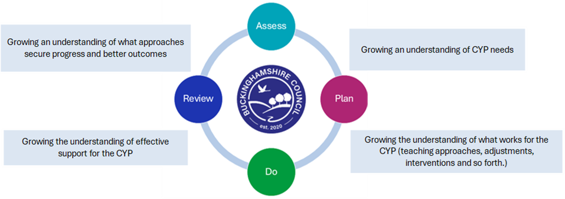
All professionals working with CYP play an essential role in applying the graduated approach. The approach is based on four key stages: Assess, Plan, Do, Review (APDR).
Assess
The child or young person’s needs are carefully identified through assessment. This involves gathering views from:
- parents or carers
- where appropriate, the child or young person themselves
The process also includes input from any professionals involved and consideration of relevant information. This thorough assessment ensures that the right type of support can be planned.
Plan
The educational setting, together with all relevant parties, agrees on the specific outcomes that SEND Support aims to achieve for the CYP. Everyone involved has the opportunity to contribute to decisions about what support will be provided and when progress will be reviewed. This includes parents/carers and professionals.
Do
The agreed support is put in place. The class teacher (or equivalent) remains responsible for the day-to-day teaching and support of the child or young person. However, the Headteacher, the SENDCo and other support staff will work closely alongside the teacher to monitor how well the support is working.
Review
At the agreed review point, the support is evaluated to determine:
- whether it is making a positive difference
- whether the intended outcomes are being achieved.
This stage also involves discussing whether any adjustments to the support are needed to better meet the child or young person’s needs.
As the cycle progresses, educators grow their understanding of pupils’
- strengths
- needs
- aspirations
This allows for personalised planning.
SEND support is delivered through this cyclical model. Each phase builds upon and refines previous strategies. This ensures approaches remain effective and responsive to each learner. It facilitates progress and positive outcomes.

Download a PDF of these visuals [PDF, 300KB]
SEND Support Plan
Find out more about the SEND Support Plan to be used by schools and educational settings.
Nurture Groups
Nurture Groups consist of small classes in mainstream schools for pupils with social and emotional needs.
SEND and Inclusion toolkits
Information and toolkits are available for professionals to support CYP, and their families. Additionally, links to toolkits for parents and carers are provided.
When to request an Education, Health and Care Needs assessment
If you and the professionals who support your child believe s/he requires support which is over and above that ordinarily and universally available from mainstream resources, a request may be made for an EHC Needs Assessment. The request will usually be made by your child’s education setting, but parents can make the request themselves.
The legal test for an EHC Needs Assessment is from section 36 of the Children and Families Act 2014.
Role of the SENCO and EHCCO
Special Educational Needs Coordinators (SENDCos) operate within educational settings to support CYP with SEND. They work closely with Education, Health, and Care Coordinators (EHCCOs) who work for Buckinghamshire SEND team to support them when an Education Health and Care Plan (EHCP) is requested or in place.
Parents and carers are encouraged to initially seek assistance and guidance from the SENDCo, as they can then collaborate with EHCCos if further advice if needed.
Forum
The forum exists to ensure that consistent, focused decision-making is aligned with current legislation. By working collaboratively and adopting a solution-focused approach, it aims to meet the needs of children and young people effectively and promote positive inclusion for all.
Exceptional support requests
A multidisciplinary team (MDT) approach is used across Buckinghamshire. This ensures coordinated and holistic support.
Resources
Children and Family Act (2014)
Early Years Foundation Stage National Curriculum (other curriculum)
Parent/Carer guidance to children’s learning and development in the EYFS
School Age National Curriculum
Specialist Teacher Support
A tiered approach to supporting children and young people with special educational needs and disabilities (SEND)
The Integrated SEND Service is part of Buckinghamshire Council’s local offer for children and young people with SEND. The service consists of a range of specialists including Specialist Teachers, Educational Psychologists and Education, Health and Care who carry out statutory services for education, health and care needs assessments, planning and monitoring.
The service is organised across the county in area hubs, which are located in Aylesbury, Wycombe and Chiltern and South Buckinghamshire. The Sensory, Physical and Down syndrome teams are countywide teams which work across the hubs.
The Integrated SEND Service works in partnership with schools, settings and post 16 providers to promote inclusion, achievement and participation, towards securing better outcomes for children and young people with SEND across Buckinghamshire.
This is done by enabling the development of skills for staff in schools and settings, typically around an individual child or young person. There is a focus on promoting an understanding of learning, development and emotional wellbeing for all.
The Integrated SEND Service works with individual schools (both maintained and non-maintained), clusters, alliances and multi-academy trusts, within Buckinghamshire. Wherever appropriate, involvement is carried out in partnership with other agencies across health and social care.
The purpose of the service is to support and facilitate effective SEND provision, ensuring that children and young people are enabled to reach their full potential and secure positive outcomes for now and for their futures.
The Integrated SEND Service supports this vision with the aims of:
- Schools/settings being supported to more ably meet the needs of children and young people with SEND.
- Schools/settings increasing in confidence so that children and young people with SEND are included and can achieve to their highest potential.
- Parents/carers gaining a better understanding of the needs of their child and will have confidence that their needs are being met within schools/settings.
Schools/settings building their own expertise through wider workforce development leading to a highly skilled system of support.
The tiered approach
The Integrated SEND Service is aimed at supporting settings when their own resources have been utilised, but where difficulties remain so that they can successfully include children and young people who have SEND. This includes those who may or may not have or require an education, health and care plan (EHCP).
The tiered approach encompasses work around the most vulnerable children and young people, based on their individual needs.
When considering involvement through the tiered approach, the needs of the child or young person will be assessed, with consideration of their individual needs and the wider context, for example, family situation, the experience of the setting, and involvement of other agencies.
The tiered approach is provided via the local authority and is free at the point of delivery, where children and young people meet the eligibility criteria.
The tiered approach includes the whole SEND system of the local area, encompassing the responsibilities that schools and settings have in relation to the SEND Code of Practice, for example, that they are expected to do the Assess, Plan, Do, Review cycle (APDR).
This includes where a pupil is identified as having SEN, schools should take action to remove barriers to learning and put an effective special educational provision in place. This SEN support should take the form of a four-part cycle through which earlier decisions and actions are revisited, refined, and revised with a growing understanding of the pupil’s needs and of what supports the pupil in making good progress and securing good outcomes.
This is known as the graduated approach and it draws on more frequent review and more specialist expertise in successive cycles in order to match interventions to the SEN of children and young people (chapter six of the SEND Code of Practice).